Stop Swallowing Everyone Else's SHIT
Source Reliability & Spin · Headlines & Hoaxes · Incentive & Indoctrination · Timing & Persuasion Techniques - the four-letter framework that catches media manipulation in 60 seconds. Left, right, center... we don't care who's shoveling it. We just tell you how deep it is.
Learn the Framework →Nobody Ever Taught You This Skill. That's Not an Accident.
Think about every skill you've ever been formally taught. Reading, writing, arithmetic. Maybe cooking. Maybe coding. Someone sat you down and said "here's how this works, here's how to get better at it, and here's what to watch out for."
Now think about media consumption. You spend three to seven hours a day doing it. It shapes your worldview, your politics, your relationships, your anxiety levels, your sense of what's true. It's probably the single most influential activity in your daily life.
And nobody ever taught you how to do it well.
Not once. Not in elementary school. Not in high school. Not in college. You got a "media literacy" unit in seventh grade where a teacher told you to "consider your sources" and then moved on to the Civil War. That's it. That was the whole education.
You can play Hot Cross Buns on a recorder. Congratulations. Can you tell when a statistic has been stripped of its context to make you afraid? Can you spot the difference between a news article and an opinion piece wearing a news article's clothes? Can you identify which emotions a piece of content was engineered to trigger before those emotions hijack your judgment?
Those aren't rhetorical questions. Those are skills. Specific, practicable, improvable skills. Just like cooking, just like coding, just like anything else worth getting good at.
SHIT Is a Skill. And Like Any Skill, It Has a Learning Curve.
When you first learn to cook, you burn everything. You follow recipes to the letter and it still comes out wrong. Then one day you start tasting as you go. You learn what "a pinch" actually means. You develop instincts. Eventually you can open a fridge, see random ingredients, and improvise something good.
SHIT works the same way.
Stage 1: Unconscious consumption. This is where most people are. Content goes in, emotions come out, and you never question the pipeline between those two events. You share posts because of how the headline made you feel. You form opinions based on whatever your feed showed you that morning. You're not dumb. You just never learned to look for the machinery.
Stage 2: Awareness. This is where it starts. You read a headline and something feels off, but you can't articulate why. You notice yourself getting angry at an article and think "wait, am I supposed to be angry right now?" You start pausing before you share. This stage is uncomfortable. It's supposed to be.
Stage 3: Analytical. Now you can name what's happening. "That headline doesn't match the article." "That claim is a straight-up hoax, here's the debunk." "That's in-group/out-group framing." You're slow at it. You have to think through each check deliberately. Like a new cook reading every line of the recipe. But you're catching things you never would have caught before.
Stage 4: Instinctive. The framework becomes automatic. You read a headline and your brain runs the checks without being asked. You watch a TikTok and you clock the ominous music, the rapid cuts, the text overlay trick before the video even finishes. You develop what experienced journalists call "a nose for it." Except now everyone can have that nose, not just people who went to J-school.
Most people never get past Stage 1 because nobody told them Stage 2 existed. The SHIT framework gives you the vocabulary. Practice gives you the reps. And like any skill, the reps are what make you good.
You're Being Played. Every Single Day.
Here's something nobody in media wants to admit: you don't have a misinformation problem. You have a manipulation problem.
Most of the content designed to make you angry, scared, or tribal isn't technically lying. That's what makes it so effective. The headlines are worded just carefully enough. The stats are real but cherry-picked. The quotes are accurate but ripped from context so aggressively they'd need a chiropractor.
And it works on everyone. Progressives share articles with missing context just as often as conservatives share articles with loaded framing. The algorithm doesn't care about your politics. It cares about your attention. And outrage, fear, and tribal belonging are the three cheapest ways to get it.
You've probably felt it yourself. You read a headline that made your blood boil. You shared it. Then three days later, you saw the full story and thought, "Huh. That was... different than I thought."
That moment? That's SHIT.
Source Reliability & Spin. Headlines & Hoaxes. Incentive & Indoctrination. Timing & Motive. Four checks, eight red flags, and once you learn to spot them, you can't unsee them. Like finding a hair in your food at a restaurant. Except the restaurant is your entire information diet, and the hair is everywhere.
The SHIT Framework: 4 Letters, 8 Checks, Zero Tolerance for Spin
This is the whole system. Four letters, two checks each, eight total red flags. You can memorize it in five minutes and use it for the rest of your life. No app required. No subscription. Just a mental checklist that works on every piece of content you'll ever consume.
The beauty of this framework is that it doesn't care about ideology. It cares about technique. A left-leaning outlet using fear tactics gets flagged the same as a right-leaning outlet burying counter-evidence. Manipulation is manipulation. Period.
Source Reliability & Spin
Is this source credible? Do they have a track record of corrections, retractions, or known bias? Then: is the framing neutral, or is it quietly steering you toward a conclusion before you've seen the evidence?
Headlines & Hoaxes
Does the headline actually match the article? (You'd be shocked how often it doesn't.) Is the claim even real, or is it a hoax that's been debunked a hundred times but keeps circulating because it confirms what people want to believe? We check the headline against the content and the content against reality.
Incentive & Indoctrination
Who profits if you believe this? Follow the money, the clicks, the political capital. There's a difference between "here's what happened" and "here's why you should be furious." We also check for in-group/out-group language, the "us vs. them" framing that turns news into tribalism.
Timing & Persuasion Techniques
Why are you seeing this NOW? Timing is everything in manipulation. Content drops before elections, during crises, or right when a counter-narrative needs burying. We check when it was published, what it's distracting from, and who benefits from you seeing it at this exact moment. If the timing feels urgent, ask why.
Each check is binary. Clean or red flag. No mushy "somewhat concerning" hedging. Either the content does the thing, or it doesn't. Your final score tells you exactly how much SHIT you're dealing with.
Print it. Screenshot it. Tattoo it on your forearm. The next time you're scrolling your feed at 11 PM and something makes you want to rage-share, run the four letters in your head. S - H - I - T. It takes sixty seconds and it will save you from being someone else's useful idiot.
What's Your SHIT Level?
Like any skill, SHIT has levels. Most people are stuck at Level 1 and don't know it. Figure out where you are, then use the roadmap to level up.
You read headlines and react. You share things because of how they made you feel. You've never once asked "what did this article leave out?" Your opinions were installed by your feed and you think you arrived at them independently.
Signs you're here: You've shared something and later found out it was misleading. You argue about articles you didn't finish. You think media bias only exists on the other side. Your blood pressure rises every time you open a news app.
You've started noticing that some headlines feel... off. You can't always explain why, but your gut is beginning to flag things. You occasionally pause before sharing. You've caught yourself mid-outrage and thought "wait, is this real?"
Signs you're here: You sometimes check if a headline matches the article. You've Googled something to verify before sharing it. You've noticed the same story framed completely differently by two sources.
How to level up: Learn the four letters. Start with H - Headlines & Hoaxes. For one week, read every article you'd normally just scan the headline of. Compare the headline's claim to what the article actually says. Then check if the underlying claim is even real. You'll be shocked how often headlines don't match their own articles, and how often the whole story is a recycled hoax. That shock is your SHIT instinct waking up.
You can name the techniques. "That headline doesn't match the article." "That claim is a known hoax — here's the original debunk." "That's tribal framing." You run the checks deliberately, like a new cook following a recipe. It's slow, but you catch things you never would have caught before.
Signs you're here: You can identify which letter of SHIT a piece of content fails on. You've caught manipulation from your own favorite sources. You've explained the framework to someone else. Your sharing has dropped dramatically because most things don't pass the smell test.
How to level up: Focus on T - Timing & Persuasion Techniques. Every time a story hits your feed, ask "why now?" Check the publish date. Look at what else is happening in the news cycle. Notice when stories conveniently drop right before a vote, a hearing, or a weekend when nobody's paying attention. Then ask who benefits. Follow the money, the clicks, the political leverage. This is where you develop range.
The framework runs automatically. You read a headline and your brain flags the manipulation before you finish the sentence. You watch a TikTok and clock the ominous music, the rapid cuts, the text overlay trick before the video ends. You developed what journalists call "a nose for it" - except now you don't need a journalism degree to have one.
Signs you're here: You spot manipulation in real-time without consciously running the checks. Your friends send you articles and ask "is this legit?" You're harder to upset because you see the emotion engineering before it lands. You consume less media overall but understand more.
How to level up: Teach someone else. Seriously. The best way to master SHIT is to explain it to someone who's never heard of it. Find a Level 1 in your life - they're everywhere - and walk them through the framework using content they care about. When you can diagnose SHIT on the fly in a live conversation, you've graduated.
You don't just spot SHIT - you understand why it was made. You see the business model behind the manipulation. You understand that the outrage article exists because outrage gets clicks, clicks sell ads, and ads pay salaries. You see the content ecosystem as a system, not a series of individual bad actors.
At this level, you're not angry at media anymore. You're not even disappointed. You understand the incentive structure and you've opted out of being fuel for it. You consume information on your terms, from sources you've vetted, and you help others do the same.
Signs you're here: People come to you before sharing things. You can explain both sides of any issue better than most partisans can explain their own. You've converted at least one Rage-Sharer into a critical thinker. Your information diet is smaller, calmer, and more accurate than anyone you know. You read a manipulative headline and your first thought isn't outrage - it's "who paid for this and what do they want?"
You knew too much. You saw the whole machine - who funds it, who benefits, how every outrage cycle is manufactured and sold. You started asking questions that made powerful people uncomfortable. You connected dots that weren't supposed to be connected.
Your last known message was a group text that read "guys I figured out why they-" and then nothing.
Signs you're here: You're not. Nobody is. Everyone who reached Level 6 died in unrelated accidents that were completely normal and definitely not suspicious. Please stop asking about Level 6. There is no Level 6. This section doesn't exist. Keep scrolling.
Be honest with yourself about where you are. Most people reading this are Level 1 or 2. That's not an insult - it's a starting point. The fact that you're on this page at all means you're already moving. The gap between levels isn't talent or intelligence. It's reps. Put in the reps and you'll climb faster than you think.
What SHIT Looks Like in the Wild
These patterns are everywhere - in your news feed, your group chats, the videos your algorithm serves you at midnight. Once you see them spelled out, you'll start noticing them in every scroll session. Sorry in advance.
The actual article cites one think-tank analyst (not plural "experts") who said the policy "could create challenges for some small businesses in the short term." The word "destroy" appears nowhere in any quote. The headline manufactured a crisis that the reporting doesn't support.
True. But crime dropped 60% over the previous three years, making the current rate still well below the 5-year average. The stat is accurate. The impression it creates is a lie. That's SHIT at its finest.
The actual information in the video is publicly available budget data. The music, pacing, and text overlays manufacture a conspiracy atmosphere around boring, accessible public records. The content isn't wrong. The packaging is pure manipulation.
States the fact. Acknowledges both sides briefly. Points to the primary source so you can read it yourself. No adjectives doing emotional labor. No unnamed "experts." This is what clean reporting looks like.
What Happens When Your SHIT Is Weak
You know these people. You might be one of them. No judgment - most of us are, because nobody ever taught us otherwise.
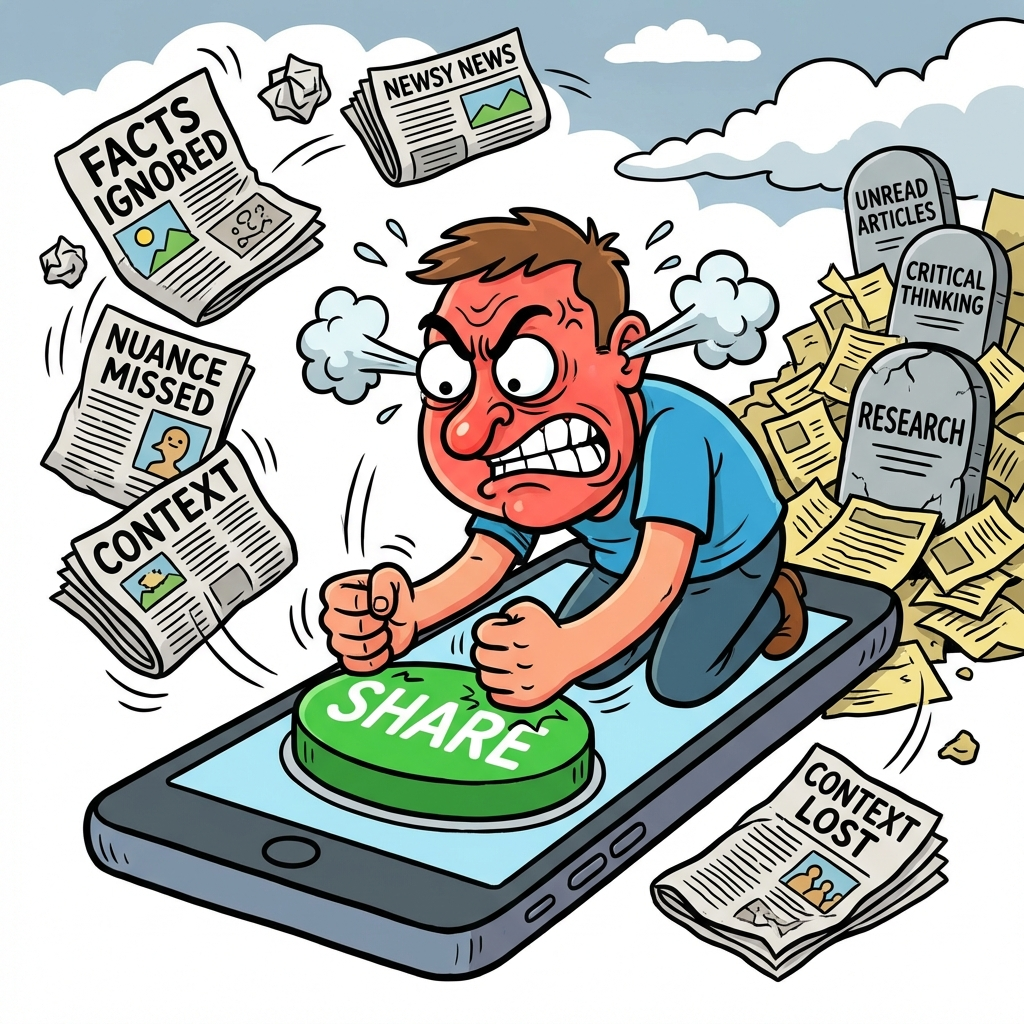
The Rage-Sharer. Reads a headline, blood pressure spikes, hits share before finishing the first paragraph. Their feed is a graveyard of articles they never actually read. They're not spreading information - they're spreading emotions. And the algorithm loves them for it because every rage-share trains the machine to serve more rage.

The Bubble Dweller. Only consumes content that confirms what they already believe. Every source they trust happens to agree with them on everything. What a coincidence. They think they're "well-informed" because they read a lot. But reading a lot of the same angle isn't research - it's reinforcement. It's like saying you have a diverse diet because you eat at five different McDonald's.
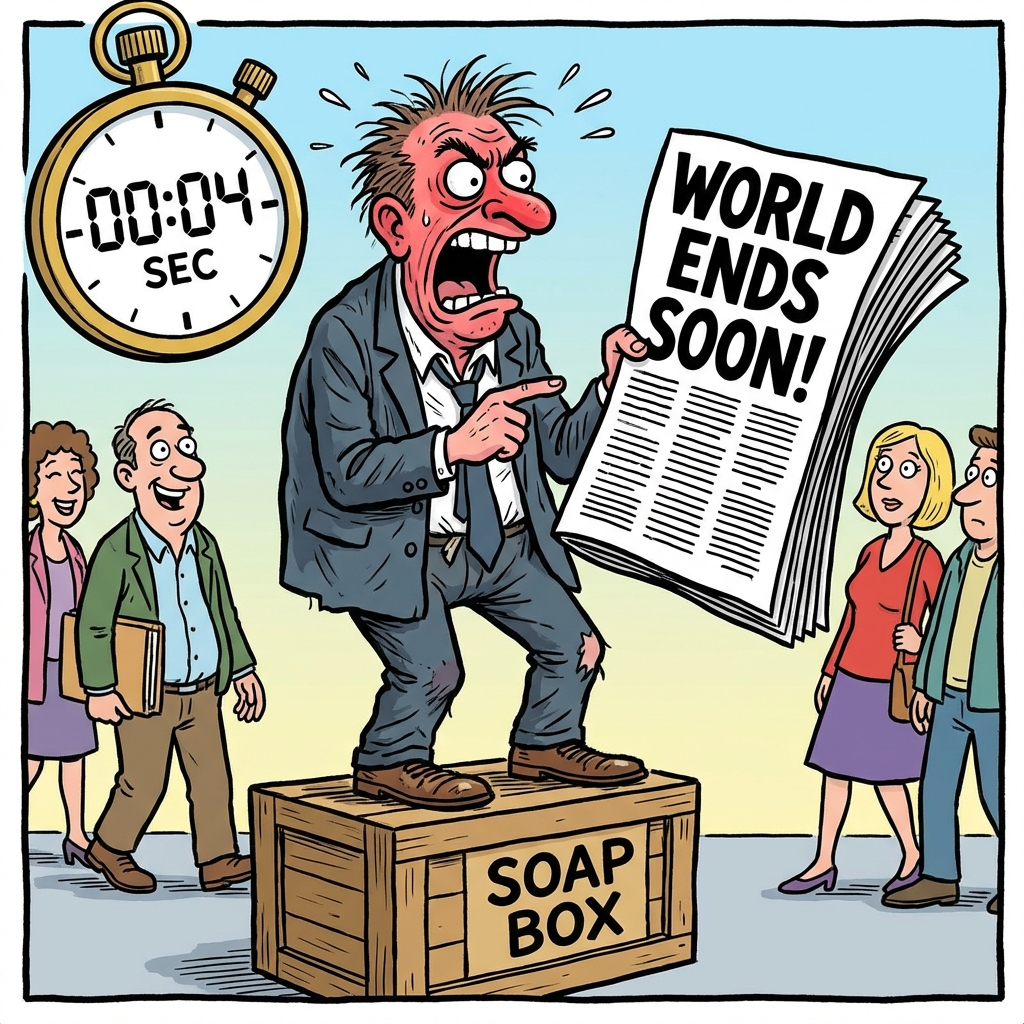
The Headline Debater. Has strong opinions about articles they've only read the title of. Will argue for twenty minutes about a story they spent four seconds on. When you ask "did you read the whole thing?" they pivot to "well, the point still stands." The point doesn't stand. The point never left the headline.
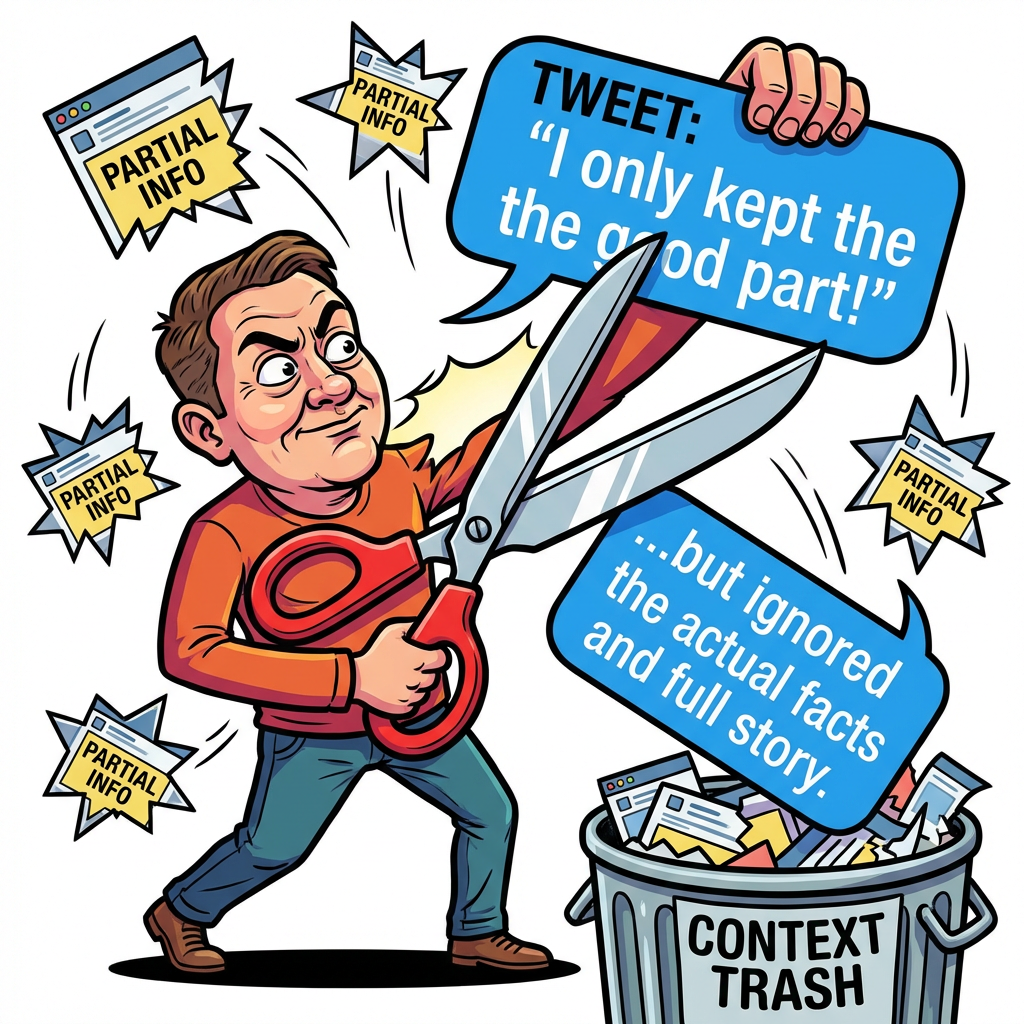
The Screenshot Warrior. Shares cropped screenshots of tweets, texts, and articles with zero context. A quote without context is just words doing whatever the screenshot-taker wants them to do. It's the informational equivalent of cutting someone's sentence in half and pretending that's what they said.

The "Do Your Research" Person. Tells everyone to "do their own research" but their research is watching YouTube videos from people who agree with them. Actual research involves reading things that challenge your position. If your "research" never makes you uncomfortable, you're not researching - you're shopping for confirmation.
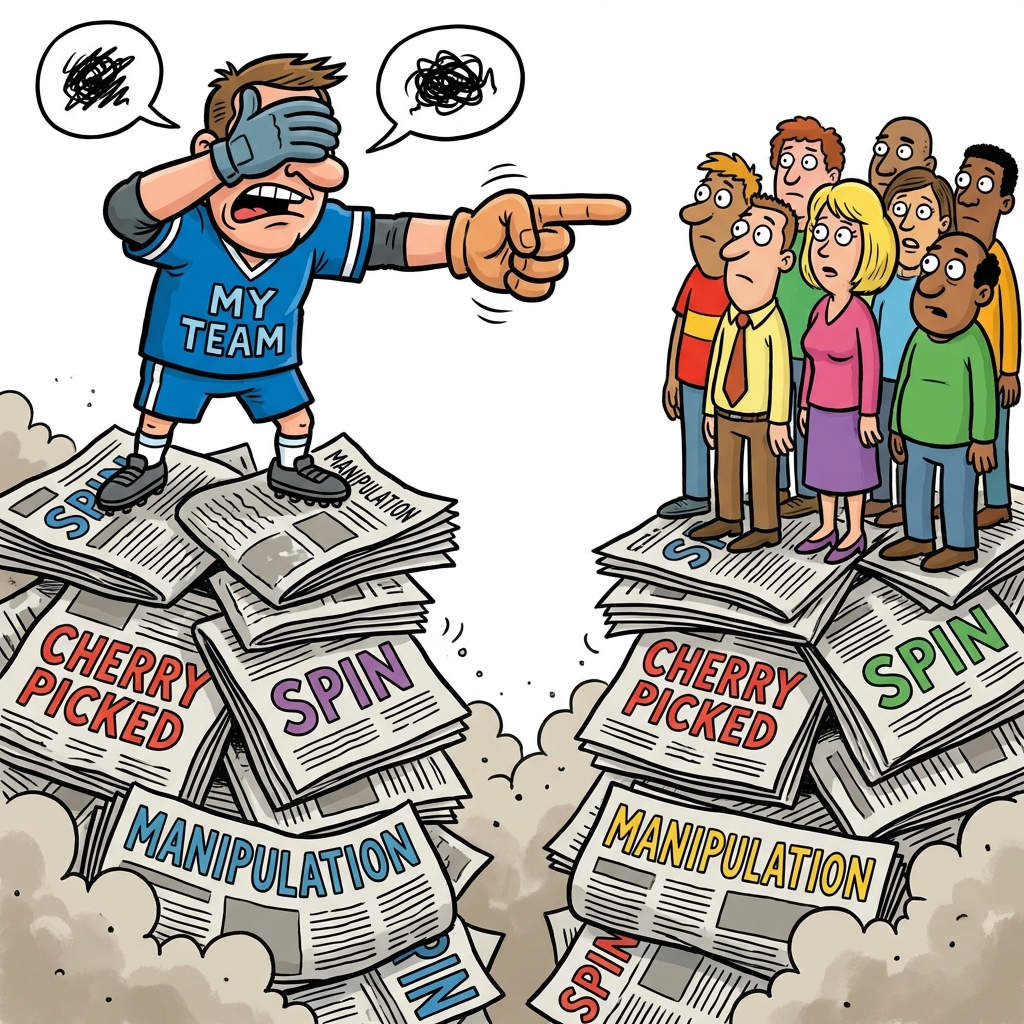
The Blame Gamer. Fully convinced that manipulation only happens on the other team. Their sources are clean, their media is honest, and anyone who suggests otherwise is brainwashed. This person is the easiest to manipulate because they've already decided they're immune. Nobody who thinks they can't be fooled is paying attention.
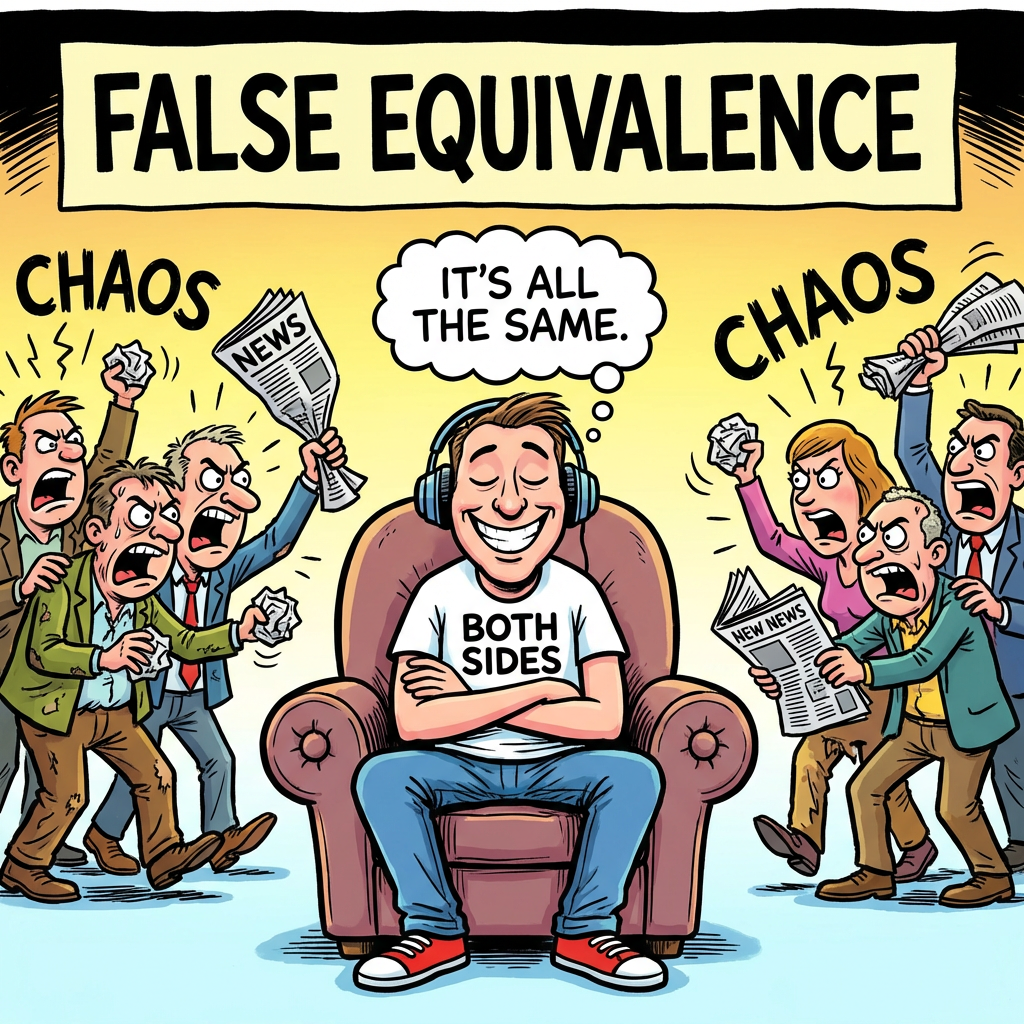
The Both-Sides Denier. Uses "both sides are the same" as an excuse to check out entirely. Wears false equivalence like armor. If everything is equally bad, nothing requires action, and they never have to do the uncomfortable work of actually evaluating anything. They think they're above the fray. They're not. They're just disengaged — and disengaged people are the easiest to govern, sell to, and manipulate. Apathy isn't enlightenment. It's surrender with a smug face.
of people think they're better than average at spotting misinformation. That math doesn't work. And that overconfidence is exactly what makes manipulation so effective.
None of these people are stupid. That's the thing. They're smart, capable, often successful people who never learned one specific skill. You wouldn't call someone dumb for not knowing how to cook if nobody ever showed them a kitchen. SHIT is the same thing - it's a skill nobody taught, and the people who profit from your ignorance are counting on it staying that way.
The good news? Every single one of these patterns disappears once you get good at SHIT. The Rage-Sharer starts pausing. The Bubble Dweller starts branching out. The Headline Debater starts reading. Not because someone shamed them into it - but because once you can see the manipulation, participating in it feels embarrassing. Like finding out you've been clapping at the wrong moments during a concert. Once you know, you just... stop.
When Bad SHIT Gets Serious
The archetypes above are funny until they're not. Because weak SHIT doesn't just make you annoying on social media. Left unchecked, it escalates. And the escalation follows a pattern so predictable it might as well be a script.
Stage 1: The Feed Takes Over
It starts small. You follow a few accounts that make you feel something. Outrage, fear, righteous anger - doesn't matter which flavor. The algorithm notices. It serves you more. Your feed slowly becomes a single emotion on repeat, and you don't notice the shift because each individual post seems reasonable. It's the accumulation that changes you.
You start spending more time online. Not because you decided to, but because every time you open your phone, something urgent is waiting. Something that needs your attention. Something that confirms the world is exactly as bad as you suspected. The dopamine loop tightens. You check your phone 90 times a day and every check reinforces the same narrative.
Stage 2: The Real World Shrinks
Your conversations change. Everything becomes about the thing - the issue, the outrage, the cause. Friends start avoiding certain topics around you. Then they start avoiding you. Your family walks on eggshells. Someone you've known for twenty years says "you've changed" and you think they're the problem. They haven't woken up. They don't see what you see.
Except what you see has been curated by an algorithm optimized for engagement, fed through sources optimized for clicks, and framed by people who profit from your anger. You didn't arrive at your worldview. You were led to it, one emotionally manipulated headline at a time.
Americans have cut off a friend or family member over politics. Not over genuine moral disagreements - over manufactured outrage built on incomplete information that neither person verified.
Stage 3: You Become the Content
Then comes the moment. The rally. The protest. The march. The thing that feels like doing something.
And here's where it gets dark: the same media machine that radicalized you now films you. You're not the audience anymore - you're the content. You're the footage that gets cut, edited, and framed to radicalize someone on the other side. Your face ends up in someone else's feed as proof that "those people" are dangerous, unhinged, a threat. A producer somewhere selects the angriest 8 seconds of your day and broadcasts it to millions.
You showed up because you believed something needed to change. You became a pawn in a content cycle designed to generate more anger, more clicks, more engagement. Both sides of the media ecosystem thank you for the material.
Stage 4: The Wreckage
Your sister doesn't call anymore. Your college roommate muted you six months ago. Your kids have a group chat you're not in where they discuss "what to do about mom/dad." Your coworkers have learned which topics are landmines. The person you were five years ago would barely recognize the person you are now - not because you grew, but because you were slowly, methodically narrowed.
And the cruelest part? You're not wrong about everything. There are real problems. Real injustices. Real things worth being angry about. But the SHIT-soaked media you consumed didn't give you accurate information about those problems. It gave you a caricature. It took real issues and inflated them, stripped their nuance, removed the counterarguments, and served them to you as emergencies that required your outrage right now.
You had real concerns. SHIT turned them into a personality.
This Doesn't Have to Be You
Every person in that spiral started the same way: consuming media without the skills to see the manipulation. That's it. They weren't dumber than you. They weren't weaker. They just never learned SHIT.
The distance between "normal person scrolling their phone" and "someone who lost friends and showed up at a rally they can't fully explain" isn't a cliff. It's a slow ramp. And the only thing that stops the slide is the ability to look at a piece of content and ask: is this informing me, or is it activating me?
That's the I in SHIT. And it might be the most important letter.
⚠️ The SHIT Foundation Does Not Recommend Short-Form Video Content
This is our most controversial position and we're stating it plainly: Instagram Reels, TikToks, and YouTube Shorts are the most effective brainwashing delivery system ever invented. And we don't think most people should be consuming them.
Here's why. There are two ingredients required to change someone's beliefs:
Repetition + Attention.
That's it. That's the entire formula behind every successful propaganda campaign in history. Repeat a message enough times to someone who's paying attention, and their opinion will shift. Not because the message is true. Not because the argument is good. Simply because the human brain treats familiarity as truth. Psychologists call this the illusory truth effect - the more you hear something, the more true it feels, regardless of whether it actually is.
Now think about what short-form video platforms are engineered to do:
They maximize your attention. The infinite scroll. The autoplay. The dopamine hit of each new video. The algorithm learning exactly what keeps YOU watching. These platforms are attention-capture machines built by the smartest engineers in the world, and they are extraordinarily good at their job.
They maximize repetition. Not of the same video - that would be obvious. But of the same narratives, the same framing, the same emotional triggers, packaged in slightly different videos from slightly different creators. You don't see the same clip twice. You see the same IDEA five hundred times wearing five hundred different outfits.
An article gives you one shot to persuade you and you can fact-check it. A short-form video feed gives a narrative thousands of shots, 30 seconds at a time, and you never think to check any of them because each individual video feels too small to matter.
The average Reels user watches over 500 short videos per week. Each one deposits a tiny frame into your worldview. After a month, you hold opinions you never consciously chose to adopt.
How the Brainwash Cycle Works
Week 1: The algorithm shows you a clip that gets a reaction. Maybe it's funny. Maybe it's outrageous. You watch it twice. You don't think about it again.
Week 2: You've now seen 15 videos with the same underlying message from 15 different creators. You didn't seek them out. The algorithm served them because you engaged with the first one. The message starts feeling familiar. Familiar starts feeling true.
Week 4: You now have a strong opinion about something you never researched, never read a long-form article about, and never heard a counterargument to. You think it's YOUR opinion. It's not. It was installed, 30 seconds at a time, by an algorithm that noticed what made you stop scrolling.
Week 8: Someone challenges your new opinion and you get defensive. You can't cite a source because you never read one. You just "know" it's true because you've "seen it everywhere." What you've actually seen is the same narrative on repeat, served by a machine that doesn't care about truth - only watch time.
Why SHIT Is Harder on Short Video
With a written article, you can pause, re-read, fact-check, and think. The text sits still while your brain processes it. You're in control of the pace.
Short-form video removes all of that. The content moves at the creator's pace, not yours. There's no time to run the SHIT checks. The music manipulates your emotions before your conscious mind even engages. The edit cuts are designed to keep you watching, not thinking. And by the time the video ends, the next one is already playing.
Even someone with strong SHIT skills has a hard time analyzing content that's specifically designed to bypass analysis. It's like trying to taste-test food that's being thrown at your face. Technically possible. Practically pointless.
Our Recommendation
Stop watching short-form video content entirely. Or at minimum, understand what it's doing to you. If you must scroll Reels, TikTok, or Shorts, limit it aggressively and pay attention to the opinions you hold afterward that you can't trace back to a real source. Those opinions weren't formed. They were deposited.
We know this is a hard sell. These platforms are designed to be addictive and they're wildly entertaining. But the SHIT Foundation exists to tell you the truth about media manipulation, even when the truth is inconvenient. And the truth is: short-form video is where critical thinking goes to die.
Read long-form articles. Watch full-length documentaries. Listen to hour-long podcasts where ideas get challenged. Consume media that gives your brain time to think. Your opinions should be the product of deliberate thought, not algorithmic repetition.
"I Don't Need This." Yes, You Do.
Some people will read this entire page and decide it doesn't apply to them. They're wrong. And here's why their refusal to improve their SHIT is one of the most dangerous decisions they can make - not just for themselves, but for everyone around them.
"I'm already good at spotting fake news."
No, you're not. Studies consistently show that people who are most confident in their ability to detect misinformation are among the worst at actually doing it. That confidence is the problem. It makes you stop checking. It makes you lower your guard with sources you already trust. And the people who manipulate media for a living are counting on exactly that - your certainty that you're too smart to be fooled.
The Dunning-Kruger effect isn't just a fun fact you share at parties. It's the engine that makes propaganda work. The less skilled you are at detecting manipulation, the more confident you feel that you don't need the skill. That's not a coincidence. That's the design.
"I don't have time for this."
You spend 3-7 hours a day consuming media. You have time to scroll, to watch, to share, to argue in comment sections. You have time to be manipulated. What you're saying is you don't have time to stop being manipulated. That's like saying you don't have time to look both ways before crossing the street. The time investment is tiny. The consequences of skipping it are enormous.
Learning the SHIT framework takes less time than watching one Netflix episode. Practicing it adds maybe 10 seconds to your media consumption - a brief pause before you react, share, or form an opinion. Those 10 seconds are the difference between being informed and being used.
"Both sides are bad, so why bother?"
This is the most insidious excuse because it sounds wise. It sounds like you've transcended the game. But "both sides are bad so I'll just consume whatever" is like saying "all restaurants have health violations so I'll eat off the floor." The existence of a universal problem doesn't justify doing nothing about it. It's the reason to do something about it.
Yes, manipulation exists everywhere. That's exactly why you need the skill to navigate it. Throwing your hands up isn't enlightenment. It's surrender. And the people shoveling SHIT love it when you surrender, because a disengaged person is just as useful to them as a radicalized one - maybe more, because you won't even put up a fight.
"I only watch/read [trusted source], so I'm fine."
There is no source on earth that is clean 100% of the time. None. Your favorite journalist has bad days. Your most trusted outlet has incentive structures that sometimes compromise their coverage. The newspaper that's been "reliable for 150 years" still writes headlines designed to get clicks in 2026.
Trusting a single source unconditionally isn't loyalty. It's the same thing as trusting a single person unconditionally - it's a setup for betrayal. The SHIT framework doesn't ask you to stop trusting sources. It asks you to verify trust continuously. That's not cynicism. That's how trust actually works in every other area of your life.
Here's What Happens When You Refuse
Every opinion you hold that you can't defend with specific evidence? That opinion was probably installed by someone else's content. Every argument you've had where you couldn't cite a source? You were repeating someone else's framing. Every time you felt certain about something but couldn't explain why? That certainty was manufactured.
Without SHIT skills, you are a vehicle for other people's agendas. Full stop. You share what they want you to share. You feel what they engineered you to feel. You vote based on narratives they constructed. You fight with people they want you to fight with. You are, in the most literal sense, not thinking for yourself - you're thinking what an algorithm decided you should think.
And the worst part? You'll defend those installed opinions as if they're your own. You'll get angry at anyone who questions them. You'll mistake the intensity of your feelings for the validity of your position. And you'll never know the difference, because you never learned the one skill that would show you.
are the product. Your attention is sold. Your emotions are monetized. Your outrage is someone else's revenue stream. The only way to stop being the product is to see the machinery. That's what SHIT teaches you. Refusing to learn it isn't independence. It's choosing to stay on the assembly line.
You wouldn't let someone else control your bank account. You wouldn't hand a stranger the keys to your house. So why are you letting algorithms and content creators control what you believe, who you trust, and how you feel about the world?
Learn SHIT. Not because we said so. Because the alternative is letting everyone else do your thinking for you. And they are not doing it in your interest.
"So Nothing Matters Then?"
This is the most common pushback to the SHIT framework. If all media is manipulated, all sources are biased, and all facts can be leveraged to push an agenda... then doesn't the logical conclusion become nihilism? Nothing is real, no opinion is valid, and we should all just give up?
No. And that conclusion is a misunderstanding of what the framework actually says.
Here's an analogy. All food can potentially carry bacteria. Every kitchen, every restaurant, every grocery store. Does that mean eating doesn't matter? Does that mean you should stop cooking? Of course not. It means you wash your hands. You cook your chicken to 165°. You check the expiration date. The existence of contamination isn't an argument against eating. It's an argument for food safety.
The SHIT framework is food safety for your information diet. It doesn't say "nothing is true." It says "check before you swallow."
The Framework Doesn't Kill Opinions. It Upgrades Them.
Two people can look at the exact same issue - say, federal spending, immigration, healthcare - and reach completely different conclusions. If both of them checked their sources, read past the headline, looked for what was missing, and asked who benefits from the framing? Those are both valid opinions. Disagree all day long. That's healthy. That's democracy. That's how it's supposed to work.
But if one person read a 2,000-word analysis from multiple sources with full context, and the other person read a headline and got angry - those are not equal opinions. One was formed. The other was installed. The framework doesn't make them both worthless. It reveals which one did the work.
"Everything Is Biased" Is Not The Same As "Everything Is Equally Wrong"
Yes, every source has some bias. Every human has some bias. You have bias. I have bias. That's the starting point, not the conclusion. The question isn't whether bias exists. The question is what you do about it.
A doctor has biases. They still diagnose you better than a random person on YouTube - because they have training, methodology, and peer review. The bias doesn't cancel out the process. Same with media consumption. Someone who checks sources, reads full articles, looks for missing context, and questions timing isn't "equally biased" as someone who rage-shares headlines. They're both biased. One of them is managing it. The other is being managed by it.
"I Could Be Wrong" Isn't An Insurance Policy. It's The Whole Point.
Some people hear "I could be wrong about this" and interpret it as hedging. Weakness. A lack of conviction. But think about the alternative. What does it look like when someone can never be wrong? What do you call a person who is 100% certain about everything, refuses to update their views with new information, and treats any challenge as a personal attack?
You call them a cable news host. Or an algorithm. Or a cult leader.
The willingness to be wrong is the single thing that separates thinking from ideology. It's not a bug in the framework. It's the feature that makes everything else work. If you can't be wrong, you can't learn. If you can't learn, you're just performing certainty - and the people who profit from your certainty are counting on you never questioning it.
The Real Question
If someone keeps finding problems with the content you trust - misleading headlines, missing context, emotional manipulation techniques - the question shouldn't be "why do they keep finding problems?"
The question should be: "why does the content I trust keep having problems to find?"
The SHIT framework doesn't lead to "nothing matters." It leads to higher quality disagreement. It means your opinions survive scrutiny. It means when you argue a position, it's because you chose it with full information, not because someone fed you half the story and an emotion. That's not nihilism. That's the opposite of nihilism. That's giving a shit.
If the SHIT Concept Makes You Angry, Read This Carefully.
Some people read this site and get mad. Not at the manipulation. Not at the media. At us. At the idea that someone would dare suggest they might be getting played.
If that's you right now - if you're feeling defensive, irritated, or dismissive - we need you to sit with that feeling for a second. Because that reaction is the most important data point on this entire page.
Ask yourself: why does a framework for checking media quality make you uncomfortable?
If someone handed you a tool that checks whether your car mechanic is overcharging you, you'd say "great, thank you." If someone showed you how to tell whether a restaurant kitchen is clean, you'd be grateful. If someone taught you how to spot a scam email, you'd forward it to your parents.
But someone shows you how to check whether the content shaping your worldview is manipulating you, and suddenly you're angry? That's not a rational response to a media literacy framework. That's a defense mechanism. And it's worth examining what it's defending.
Here's what it usually comes down to:
You're afraid your favorite sources won't pass the test. Deep down, you suspect that some of the content you trust uses exactly the techniques we're describing. And if you learn to see it, you'll have to do something about it - change your sources, change your opinions, or live with the cognitive dissonance. All three options are uncomfortable. So your brain attacks the framework instead of engaging with it. Much easier to say "this is stupid" than to say "this might apply to me."
You've built an identity around your media diet. Your sources aren't just where you get information - they're part of who you are. Questioning them feels like questioning yourself. So when someone suggests those sources might be using manipulation techniques, it doesn't feel like media criticism. It feels like a personal attack. It's not. But your brain can't tell the difference because you've fused your identity with your information sources.
The concept threatens something you've invested in. If you've spent years sharing content, arguing with people, and forming opinions based on manipulated media - the idea that you might have been wrong isn't just intellectually uncomfortable. It means all those arguments, all those lost friendships, all that emotional energy was spent on someone else's agenda. That's a genuinely painful realization. And your brain would rather reject the framework than face it.
We get it. Seriously. This isn't easy. Nobody likes finding out the ground they've been standing on is less solid than they thought.
But here's the thing: the anger you're feeling right now is exactly the emotion that manipulative media is designed to exploit. Right now, it's pointed at us. Most days, it's pointed wherever your feed aims it. Same mechanism. Same vulnerability. Different target.
The people who get the most angry at SHIT are the people who need it the most. Not because they're stupid. Because they're the most emotionally invested in content that hasn't earned that investment. And the gap between investment and reality is where all the pain lives.
So if you're angry: good. Anger means you care. Now point that anger at the right target. Not at a poop-themed media literacy site. At the machinery that's been manipulating your emotions for profit. At the algorithms that turned your genuine concerns into someone else's engagement metrics. At the content creators who took your trust and used it to sell you half the story.
Your anger is valid. Your aim is off. Let us help you fix it.
How to Get Good at SHIT (No Tool Required)
The real goal isn't an app or a website. It's rewiring how your brain processes media. These are skills, not secrets. You can start practicing them right now, on the next thing you scroll past.
Read the headline. Then stop.
Before you click, before you scroll, ask yourself one question: "What conclusion does this headline want me to reach?" If you can feel it pulling you somewhere, that pull is worth investigating. Good journalism gives you information. Manipulation gives you a destination.
Try it tonight. Open your preferred news app, social feed, or group chat. Read the first five headlines. For each one, write down the emotion it's trying to trigger. Anger? Fear? Smugness? Moral superiority? You'll be disturbed by how obvious the pattern is once you look for it.
Play devil's advocate. Against yourself.
Whatever your gut reaction is to a story, force yourself to articulate the strongest version of the opposing view. Not a strawman. The real argument. If you can't do it, you probably don't understand the issue well enough yet. And that's fine! That's actually useful information.
This is the hardest skill to build because your brain actively fights it. We're wired for confirmation. Every time you encounter information that supports what you already believe, your brain gives you a little dopamine hit. Questioning your own side feels like work because it literally is.
Check what's missing. Always.
This is the big one. The most powerful form of manipulation isn't lying. It's omission. A story about a policy's costs that never mentions its benefits. A profile of a controversy that only quotes one side. A statistic presented without the comparison data that would give it meaning.
Every time you finish reading something, ask: "Who would disagree with this, and what would they say?" If the piece never addressed that, you just found the SHIT.
Watch your emotions. They're the target.
If you feel outraged, scared, or smug after consuming a piece of content, those emotions aren't accidental. They were engineered. That doesn't mean the content is wrong. But it does mean you should slow down before you hit share.
The share button is the most powerful weapon in modern propaganda. And they've made it feel weightless on purpose.
SHIT Is Everywhere. Here's How It Changes Your Daily Life.
Once you internalize the SHIT framework, it doesn't just change how you read the news. It changes how you move through every screen you touch.
That group chat where someone drops a screenshot of a headline with "can you BELIEVE this?!" - you'll notice the headline is doing emotional labor the article doesn't support. That video in your feed with the ominous music and ALL CAPS text overlay - you'll clock the manipulation before the video even finishes. That "breaking" notification from a news app designed to make you tap immediately - you'll feel the urgency and recognize it as engineered.
It's not just political content. It's health advice that cherry-picks one study out of two hundred. It's financial "news" that manufactures urgency to get you to buy or sell. It's outrage content about strangers on the internet that exists purely to make you feel morally superior for three seconds before the algorithm serves you the next hit.
SHIT is the operating system of the attention economy. And once you see the code, you can't unsee it.
The average person spends this much time per day consuming media. Without the SHIT framework, that's 3–7 hours of unfiltered manipulation flowing straight into your worldview.
What Changes When You Start Detecting
The shift is subtle at first. Then it's everywhere.
Scrolling your feed: You start noticing how many posts are engineered to trigger a reaction rather than convey information. The rage-share impulse fades. You stop being free labor for other people's engagement metrics.
Group chats: When someone shares something inflammatory, instead of piling on or arguing, you can point to the technique. "The headline says 'destroyed' but the actual quote says 'challenged.'" You're not calling anyone stupid. You're both looking at the same breakdown.
Conversations with people you disagree with: Instead of "you're wrong," it becomes "we're both getting played." That's a fundamentally different starting point. One leads to a fight. The other leads to a conversation.
See the difference? You're not calling them stupid. You're not dismissing their concern. You're using shared vocabulary to talk about the quality of the information instead of attacking each other. The SHIT framework gives you neutral ground. It turns "you're wrong" into "we're both getting played."
SHIT: The Great Equalizer
The most powerful thing about this framework is that it hits your side too. And that's what makes it work.
The first time you catch an article from your favorite source pushing misleading headlines or recycling debunked hoaxes? That stings. Your brain will try to explain it away. "Well, they're basically right even if the framing is..." Stop. That's the manipulation working. That's the whole reason the SHIT framework exists.
When you start catching manipulation from sources you trust - not just sources you already disagreed with - that's when you know the skill is real. That's when it stops being a partisan weapon and starts being a genuine superpower.
Because a country full of people who are difficult to manipulate is the most dangerous thing imaginable to everyone who profits from keeping you stupid and angry. And every time someone pauses before rage-sharing, the algorithm loses a tiny piece of its power.
That's how SHIT changes everything. One flush at a time.
Find a SHIT Sparring Partner
Here's the counterintuitive move that will do more for your media literacy than anything else on this page: go find somebody who consumes completely different media than you. And start comparing notes on purpose.
Not to argue. Not to convert them. Not to prove you're right. To train.
Think about how every other skill works. A chess player doesn't get better by playing against themselves. A boxer doesn't improve by punching air. A programmer doesn't level up by only reading code they already understand. You get better by going up against someone who sees things differently, who catches the blind spots you can't see because they're YOUR blind spots.
That friend who watches completely different news? That coworker who's always sharing stuff you roll your eyes at? They're not your opponents. They're your training partners. They consume completely different manipulative content than you do, which means they're experts at spotting the SHIT you swallow without noticing, and you're an expert at spotting theirs.
The Rules of SHIT Sparring
This isn't a debate. It's not an argument. It's training. And like any training, it only works if both people follow the rules. Break them and you're just two people yelling about politics again. Follow them and you'll build a skill most people don't even know exists.
Never say "you fell for that." Say "look at what that article did to both of us." The second you make it about intelligence or gullibility, the conversation is over and you're just two people with hurt feelings and no new information. The content is the opponent. Not each other.
Before you touch anything from their media diet, critique something from yours. Out loud. In front of them. "Look, my favorite source ran a misleading headline here." That one sentence does more for trust than a hundred logical arguments. You just showed you're not here to win. You're here to see clearly.
The moment one person tries to "prove" the other side's media is worse, the session is dead. This isn't a competition. Both sides are drowning in SHIT. The goal is to help each other see it, not to keep score of who's drowning deeper.
When an article makes you angry, that anger is useful information. Say it out loud: "This made me furious. Let's figure out whether it earned that reaction or manufactured it." If your partner says something made them emotional, don't dismiss it. Analyze it together. Emotions aren't the enemy. Unexamined emotions are.
Don't just say "this feels off." Name the check. "That's an S problem - this source has a known bias." "That's an H - the headline doesn't match the article." "That's a T - why did this drop at 5 PM on a Friday?" The letters are the shared language. Use them. They keep the conversation clinical instead of personal.
When you spot a misleading headline or a potential hoax, don't just note it. Actually go find what's real. Together. Open a search engine, find a second source, read the full study. Two people with different media diets searching for the full picture will find it ten times faster than either of them alone.
When you find manipulation from a source you trust, don't get defensive. Get excited. Out loud. "Oh wow, my source totally did that." That reaction is contagious. It gives your partner permission to do the same when their sources fail. This is the single most powerful move in SHIT sparring.
30 minutes. One hour max. SHIT sparring is mentally draining because you're fighting your own biases the entire time. Short, focused sessions build the skill faster than marathon arguments. When the timer goes off, stop. Talk about literally anything else. Remember that this person is your friend, not your ideological project.
Each person brings one piece of content per session. Not five. Not a folder of "proof." One. You'll be surprised how deep one article goes when two people with different perspectives actually analyze it properly. Depth beats breadth every time.
Don't screenshot your partner's reactions. Don't quote them in group chats. Don't bring up what they said during a regular argument two weeks later. Sparring only works in a safe space. The moment someone feels like their vulnerability will be weaponized, they'll never be honest again. And then you're both back to square one.
Try this: once a week, you and your sparring partner each bring one article from your own media world. Run them both through the SHIT checks. Discuss what you find. No yelling. No converting. Just two people getting better at seeing manipulation, from every direction. Do it for a month and watch what happens to your conversations. Watch what happens to the trust between you. Watch what happens to the quality of information you start demanding from your own sources.
People literally pay surgeons to transplant someone else's fecal matter into their gut because a different microbiome fixes what their own body can't. This is that, but for your information diet. Someone else's SHIT contains exactly the bacteria your media ecosystem is missing.
This is the part nobody talks about when they talk about "bridging the divide." They frame it as compromise. As meeting in the middle. As if you need to give up your values to get along with somebody who sees things differently.
That's not what this is. This is two people keeping their values, keeping their opinions, keeping their perspectives, and jointly refusing to let bad-faith media make those differences worse than they actually are. You're not agreeing on policy. You're agreeing that you both deserve better information. That's a much easier handshake.
Your sparring partner sees the tricks your side uses that you've gone blind to. You see the tricks their side uses that they've gone blind to. Together, you become very difficult to manipulate. And a world full of people who are difficult to manipulate? That's the most dangerous thing imaginable to everyone who profits from keeping you stupid and angry.
So go text that friend. Message that coworker. Reconnect with someone you've been avoiding because you "disagree on everything." Don't say "let's talk politics." Say "hey, want to talk SHIT?" They'll laugh. Then you explain the framework. And just like that, the most loaded conversation in America becomes the most disarming one. You're not debating politics. You're just talking SHIT together.
It's way easier to bond over a Shartocalypse score than over ideology.
Become a SHIThead.
Every movement needs a name for its people. Lady Gaga has her Monsters. Taylor Swift has her Swifties. Beyoncé has the BeyHive.
We have SHITheads.
A SHIThead is someone who takes their SHIT seriously. Someone who pauses before they share. Someone who reads past the headline. Someone who asks "why am I seeing this right now?" instead of just reacting. Someone who's willing to catch their own side using manipulation and say it out loud.
SHITheads don't agree on politics. They don't have to. What they agree on is that everyone deserves better information and that manipulation is manipulation regardless of who's doing it. That's the whole requirement. That's the membership card.
Is the name crude? Absolutely. Will people remember it? Forever. Will you hesitate for half a second before telling your boss you're a SHIThead? Probably. But that half-second of discomfort is nothing compared to the years you spent swallowing content without questioning it.
You don't need to sign up. You don't need to pay. You don't even need to tell anyone. You just need to start running the checks. The moment you catch your first piece of manipulation - really catch it, name the technique, see the machinery - you're a SHIThead. Welcome to the club.
Put it in your bio. Say it at dinner parties. Text it to your friends.
"I'm a SHIThead, and I'm not sorry about it."
We're Building a Tool to Automate the SHIT Checks
You don't need a tool to use the SHIT framework. It lives in your head. But we're building one anyway - because the faster you can get reps, the faster the skill develops.
The SHIT Analyzer is currently in development. When it launches, it will be free to use and will work like this:
Drop in any content
Paste a URL. Paste raw text. Drop in a Reddit link. Or screen-record a TikTok, Reel, or Short (with captions on) and upload the video. It'll eat everything.
It reads everything a human would miss
The tool will pull the full text, transcript, on-screen text, visual cues, and even the emotional tone of background music in videos. Then it'll run all eight SHIT checks with specific evidence for every flag.
Get your Poop Scale score and breakdown
You'll see the rating, a point-by-point breakdown with highlighted quotes and timestamps that triggered each flag, the detected political lean (if any), and the counter-arguments the content left out. Share the score card with anyone. Watch the conversation change.
See the context that was stripped away
This is the part no other tool does. The analyzer doesn't just score what's in front of you - it goes and finds what's missing. It searches across the full political spectrum, pulls reporting from left, center, and right-leaning sources, checks primary documents and official records, and reconstructs the timeline of what actually happened.
You'll see a side-by-side: what you were told vs. what was left out. Which facts the left-leaning coverage included that the right didn't. Which facts the right-leaning coverage included that the left didn't. What the court documents, official statements, or raw data actually say. Every source gets a bias rating so you can see exactly where each piece of context comes from.
Because the biggest lie in media isn't what they tell you. It's what they don't.
Think of it like training wheels. Or a sparring dummy. It'll run the reps so you can see what expert-level SHIT analysis looks like, until you internalize the patterns yourself. The goal is for the tool to make itself obsolete - use it enough and you'll start running the checks automatically in your head. That's when you know SHIT has become instinct.
Want to be notified when the analyzer launches? Follow us or check back here. We're building this in the open and it'll be free for everyone when it's ready.
The Poop Scale: A Rating System You'll Never Forget
We made it crude on purpose. Media literacy shouldn't feel like homework. It should stick in your brain like a jingle you can't shake. So every piece of content gets a rating on our scientifically calibrated (okay, not scientifically) Poop Scale.
Pristine. Balanced, full context, minimal agenda. Rare and beautiful. You found a unicorn. Cherish it.
Mostly solid, just a tiny streak of spin. Consume with mild awareness.
Noticeable issues. It'll hold up under scrutiny, but bring extra toilet paper. Cross-reference recommended.
Heavy omissions and loaded framing. You'll be cleaning up misinformation for a while.
Messy emotional hooks and sketchy sources. Don't trust it without backup. Don't sit on white furniture.
Burning urgency, fear tactics, tribal bait. This content was designed to make you angry, not informed.
Liquid chaos. Almost every check fails. The informational equivalent of a gas station bathroom.
Total disaster. Full propaganda mode. Trust at your own risk. This content is working overtime to play you.
Reddit Gets Special Treatment
Because Reddit is where headlines go to get rewritten by strangers with agendas. Drop any Reddit link and the tool analyzes the post, compares the Reddit title against the actual source headline (this delta alone is wild), scores the comment ecosystem for dominant narratives, and flags when dissenting views are getting buried. Turns out the real SHIT was the editorialized titles we made along the way.
Analyzer Coming SoonX Posts Get the Full Colonoscopy
Most tools stop at the post. This one doesn't. Drop any X/Twitter link and you get two things: the standard SHIT score on the post itself, plus a full credibility profile of the person who posted it.
That means it pulls their last 200 tweets and actually reads them. It checks how often they post (30+ times a day across all time zones isn't human behavior). It looks at their original content ratio (all retweets, no original thought = amplifier account). It checks if they ever acknowledge the other side of an argument, or if it's rage content 100% of the time.
Then it rates the account on a credibility scale:
Real person, diverse posting, acknowledges complexity, corrects mistakes when wrong. The kind of account worth following.
Real person, clearly pushing a viewpoint. Not lying, but you're only getting one side. Think commentators, activists, advocates. Not bad. Just... know what you're getting.
Optimized for virality, not truth. Rage-bait, hot takes, manufactured outrage. May be a real person, but they treat X like a slot machine and your emotions are the coins.
Bot-like patterns. Coordinated messaging. Fake followers. Brand new account pushing narratives hard. Proceed with the caution you'd give a gas station sushi roll.
Account is clearly satirical. Content isn't meant to be taken at face value, and the profile signals that. Flagged so you don't accidentally score The Babylon Bee like it's Reuters.
The combination is what makes this powerful. A Mud Butt post from a Verified Human might just be a bad take from someone who's usually trustworthy. A Ghost Wipe post from a Suspicious Account might be a broken clock being right at noon. Context changes everything, and the profile score gives you that context.
Built for the TikTok Era
This is where most manipulation lives now. Not in 2,000-word articles. In 30-second videos with dramatic music, rapid cuts, and text overlays designed to bypass your critical thinking entirely.
Screen-record any TikTok, Reel, or YouTube Short. Turn on captions first if you can. Upload it. The tool transcribes every word, reads every text overlay, analyzes the editing pace and music tone, and scores the whole thing against the same eight checks.
That video someone shared about the "secret they don't want you to know?" It'll tell you exactly what techniques were used to make you feel like you'd uncovered hidden truth when you'd actually just watched someone with a ring light read publicly available information over ominous music.
Nothing stored. Nothing saved. Videos get processed and deleted. This isn't about collecting your data. It's about stopping other people from collecting your attention under false pretenses.
"But Aren't You Biased Too?"
Yeah, probably. Everyone is. That's sort of the whole point.
But here's the difference: the framework doesn't score opinions. It scores techniques. It doesn't care if an article concludes that taxes should be higher or lower. It cares whether the article used selective data, emotional manipulation, misleading framing, or missing context to get you to that conclusion.
A well-argued progressive piece with full context, acknowledged counterpoints, and honest framing scores a Ghost Wipe. A well-argued conservative piece with the same rigor scores a Ghost Wipe. A sloppy hit job from either side scores Mud Butt or worse.
The entire methodology is open. The scoring criteria are transparent. If you think something's wrong, say so. We'll either fix it or explain why the check works the way it does. That's more transparency than the outlets you're consuming right now are offering, and that fact alone should concern you.
Questions, Pushback, and Rebuttals
The Pushbacks
The framework doesn't tell you what to think. It tells you what to check. Source, Headlines, Incentive, Timing. Those are questions, not opinions. If checking those four things leads you to a different conclusion than someone else who also checked them, great. That's called informed disagreement and it's the healthiest thing a democracy can have. But if checking those four things threatens your current conclusion, that says something about the conclusion, not the framework.
Cults tell you to stop questioning. This framework is literally a structured method for questioning everything, including itself. Cults isolate you from outside information. This framework pushes you to consume more diverse sources. Cults have leaders you can't criticize. This framework has no leader and the methodology is fully transparent for anyone to critique. If "learn to check your sources" sounds like a cult to you, consider what it says about the information environment you're currently in that taught you to see scrutiny as a threat.
Fair challenge. And here's how to test it: send something from YOUR preferred source and ask to run the checks together. If the framework only catches manipulation from one direction, it's broken. But that's not what happens. What usually happens is people only send content from one direction, only see pushback in one direction, and conclude the framework is biased. The framework checks everything. The bias is in what you choose to submit to it.
The opposite. "I could be wrong" means "I'm confident enough in my process that I'll update my view if better evidence appears." That takes more conviction, not less. The person who can never be wrong isn't brave. They're brittle. One new fact and their whole worldview cracks, so they have to reject the fact to survive. The person who says "I could be wrong" can absorb new information without an identity crisis. That's not a cop-out. That's intellectual durability.
You don't need to. The 60-second version: read past the headline. Ask "what's missing?" Ask "why am I seeing this right now?" That's three habits, not a research project. And here's the time math that actually matters: how many hours have you spent arguing about articles you didn't fully read? How many relationships has outrage content strained? How many decisions have you made based on headlines? The SHIT framework doesn't cost you time. It saves you from the consequences of not having it.
Every single person who has ever been manipulated by media believed this exact sentence. Every one. That's not an insult. It's how manipulation works. It doesn't feel like manipulation. It feels like being informed. The content that's hardest to check is the content you already agree with, because your brain skips the verification step when the conclusion matches your existing beliefs. That's called confirmation bias and it's not a character flaw. It's factory-installed human software. The framework exists specifically because your brain won't do this automatically.
No. This isn't about intelligence. A surgeon is better at surgery than you. That doesn't make them smarter, it makes them trained. A mechanic catches engine problems you'd miss. Not because they're a genius, because they learned what to look for. Media literacy is the same thing. It's a skill. Some people have developed it, some haven't. The people who haven't aren't stupid. They just never got shown the kitchen. The SHIT framework is the kitchen.
The point is that YOU don't have to fall for it from either side. "Both sides manipulate" isn't an argument for giving up. It's the strongest possible argument for developing the skill to catch it. If both restaurants in town have health code violations, the answer isn't "food safety doesn't matter." The answer is "I should probably learn to cook." The SHIT framework is learning to cook.
Facts are real. But which facts you see, which ones get left out, how they're framed, and when they're shown to you are all editorial decisions made by someone else. A fact can be 100% true and still be misleading if it's presented without context. "Crime in City X rose 50% this year" is a fact. It's also misleading if you don't mention that crime went from 2 incidents to 3. The number is real. The framing is SHIT. That's what the framework catches: not fake facts, but real facts weaponized through selective presentation.
The Practical Questions
You can memorize the four letters in 30 seconds. You can understand the checks in 10 minutes. You'll start catching obvious manipulation within a day. Getting genuinely good at it takes a few weeks of practice. Getting great takes months. But even Level 1 awareness - just knowing the techniques exist - puts you ahead of most people consuming media today.
Articles, videos, podcasts, tweets, Instagram posts, TikToks, Reddit threads, group chat screenshots, memes, YouTube thumbnails - if it's trying to make you think or feel something, the four checks apply. The format changes. The manipulation techniques don't.
Actual satire is labeled as satire. The Onion isn't trying to fool you. What the framework catches is content that uses the aesthetics of humor or satire to sneak in genuine propaganda. "It's just a joke" has become one of the most effective shields for spreading misinformation. If the "joke" has a political conclusion and the audience is sharing it as evidence, it's not satire. It's manipulation wearing a clown nose.
Because media literacy is important and boring doesn't stick. You'll remember what "The Shartocalypse" means long after you forget the academic definition of "motivated reasoning." That's the point. We want this framework living rent-free in your head the next time you see a headline that makes your blood boil.
Please do. Everything on this site is free to use for education. Print it, screenshot it, teach it, remix it. We'd rather have a generation of kids who can spot manipulation than a generation of adults who can't. If you want a more structured experience, check out our speaking and workshop page.
You don't start with the framework. You start with an example. Find a piece of content they shared recently, and instead of saying "that's wrong," say "let me show you something interesting about how this was written." Walk through the checks together. Don't lecture. Discover together. The moment they catch the manipulation themselves is the moment the framework sells itself. Nobody likes being taught. Everyone likes feeling like they figured it out.
Share this page. Or just teach them the four letters: S-H-I-T. Source & Spin. Headlines & Hoaxes. Incentive & Indoctrination. Timing & Persuasion Techniques. Once someone knows the acronym and the Poop Scale, the framework sells itself. Especially when you score something from their favorite source and they watch it light up like a Christmas tree.
Neither. Manipulation doesn't have a party. Fox does it. CNN does it. MSNBC does it. The Daily Wire does it. Occupy Democrats does it. Your favorite podcast does it. The framework checks the technique, not the conclusion. A manipulative article pushing something you agree with is still manipulative. That's the part most people don't want to hear, and it's the part that matters most.
You'll Never Read a Headline the Same Way Again
Learn the framework. Practice the checks. Share it with everyone you know. The tool is here when you want reps - but the real goal is SHIT becoming a reflex you carry everywhere.
Analyzer Coming Soon🎤 Want a SHIT Talk at Your Event?
Keynotes, workshops, and training sessions for companies, schools, and organizations. Your audience will never forget it.
Book a Speaking Engagement →